
What it changes for the business
ClarifyDoc doesn't produce another document that goes stale. It produces a current, shared model of how the system really works — and that moves four numbers leaders care about.
De-risk modernization
Scope rebuilds, migrations and re-platforming from a real dependency and blast-radius graph — not a workshop guess. Know what's safe to touch and what's load-bearing before you commit budget.
Onboard in days, not weeks
New hires, contractors and partner teams start from a browsable map instead of shoulder-tapping. The ramp that used to cost weeks of two people's time now costs an afternoon.
Shrink key-person risk
When the system's structure lives in a shared, regenerated model instead of a few people's heads, a resignation stops being an outage waiting to happen. With git history, the report names the files only one person has ever changed, ranked by the routes and tables they carry.
An auditable source of truth
Deterministic and reproducible, versioned by content hash. The same input always yields the same map — defensible in a review, a board deck or a data room.
“The system runs the business, but nobody can draw it. The knowledge is in the code and in a handful of heads — and both are harder to read every quarter.”
— the situation ClarifyDoc is built to endDUE DILIGENCE & AUDIT
Understand a codebase you didn't build
Assessing an acquisition, a vendor's delivery or an inherited system? Point ClarifyDoc at it and get an objective read in an afternoon: a graded health score, prioritized suggestions, security findings, complexity hot-spots and the true dependency structure — no reliance on the incumbent team's narrative.
- Health score with prioritized, ranked actions
- Security findings traced across files — request input to the query it reaches, webhooks that never verify their signature
- Credentials ever committed to git history, known vulnerabilities (OSV) and a CycloneDX SBOM
- Semgrep or CodeQL findings joined to the endpoints that reach them
- Layer violations, dependency cycles and dead code — all free, no paid tier
- Complexity and duplication hot-spots
Split god-node OrderService (12 dependents)2 endpoints write Users without an auth check3 layer violations in billing/Duplicated invoice logic in 4 files+ 9 more, rankedMODERNIZATION & CHANGE-TRACKING
Decide what to keep, replace or retire
Because every file is tracked by content hash, you can diff the system between two points in time and see what actually moved. Dead modules with no inbound links stand out — the ones you can decommission without a six-week investigation.
- Diff the architecture between runs
- Spot dead code with zero inbound links
- Base the roadmap on the real graph, not folklore
# what changed since last quarter (by hash)
+ 4 new services   + 2 external integrations
~ Orders entity gained 3 fields
- LegacyBilling.*  removed (0 inbound links)

# flagged: safe to decommission
LegacyBilling  →  no callers, no routes
Safe for sensitive and regulated code
ClarifyDoc is built for exactly the codebases you can’t send to a cloud service. It runs on hardware you control — a laptop, an editor or your CI.
- Runs 100% locally — your code never leaves your machine
- No AI in the extraction pipeline — nothing is used to train a model
- Deeper call resolution uses the language servers already in your editor — no Docker
- Open source under MIT — your team can audit every extractor
- No account, no telemetry, nothing from your code sent anywhere — the opt-in vulnerability lookup sends only package names and versions
- Deterministic output — reproducible for compliance
IN THE REPORT
What you’ll actually look at
Real screenshots of ClarifyDoc’s report on RealWorld’s open-source Conduit app. Each one opens that tab in the product tour.
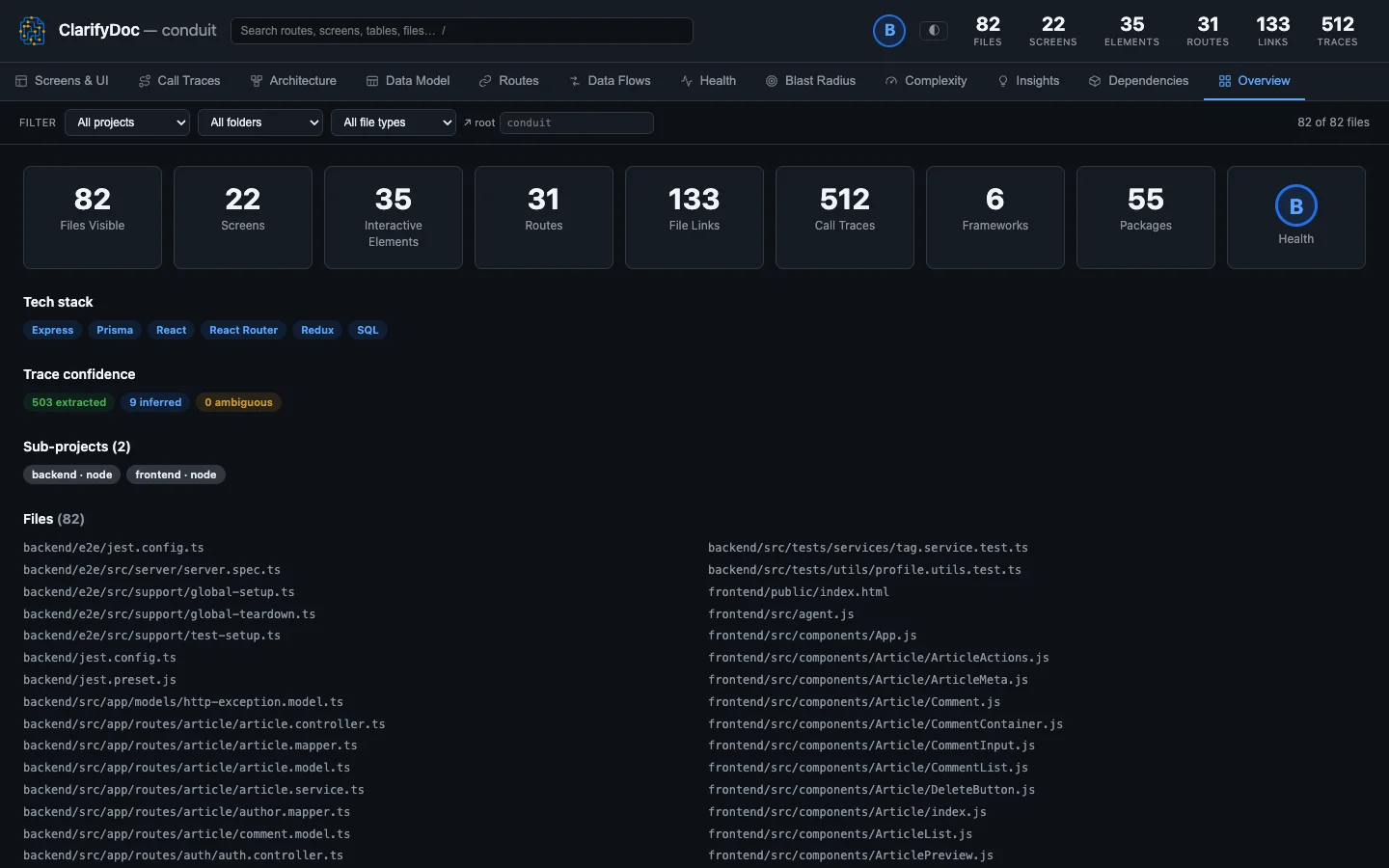 Overview
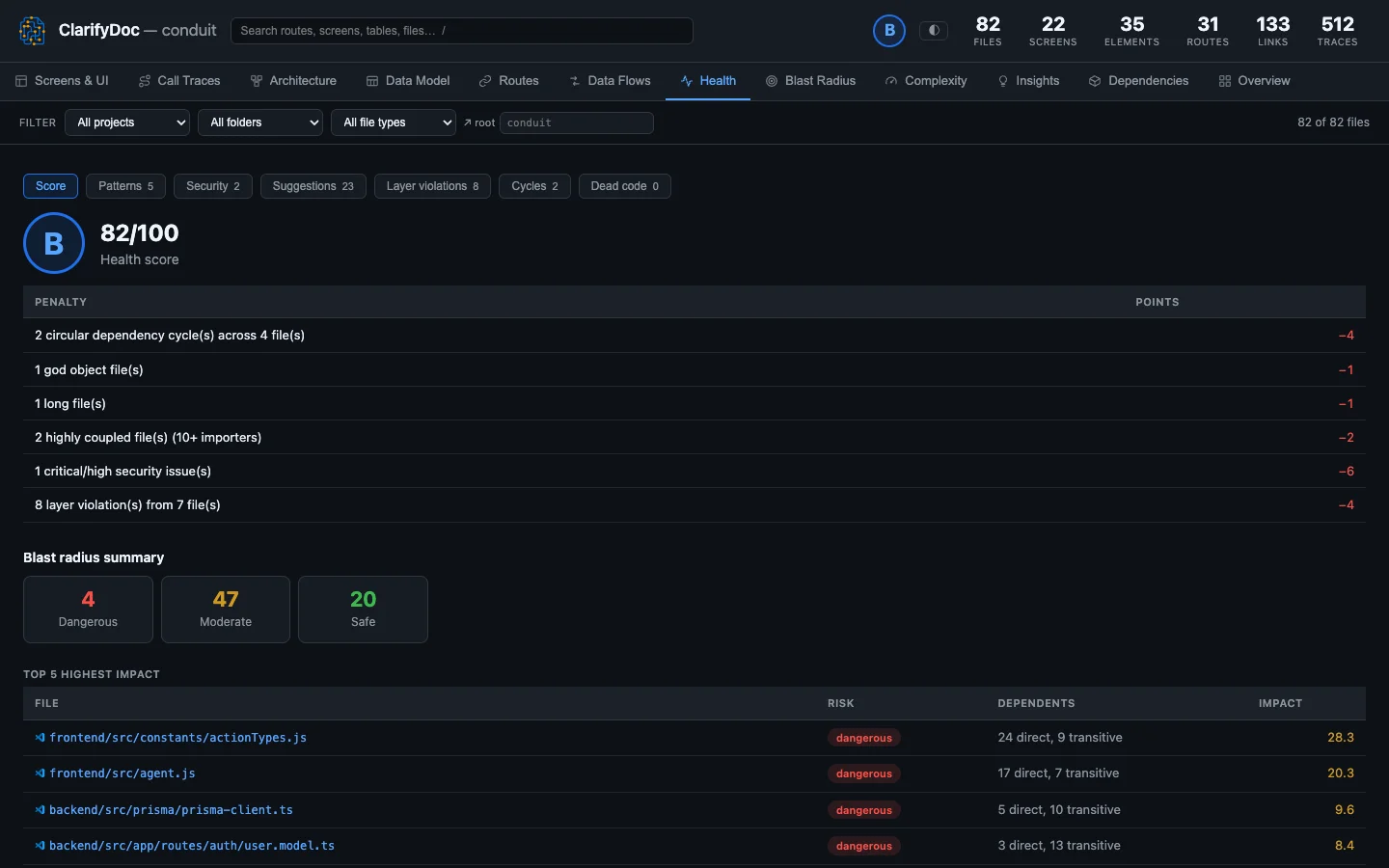 Health
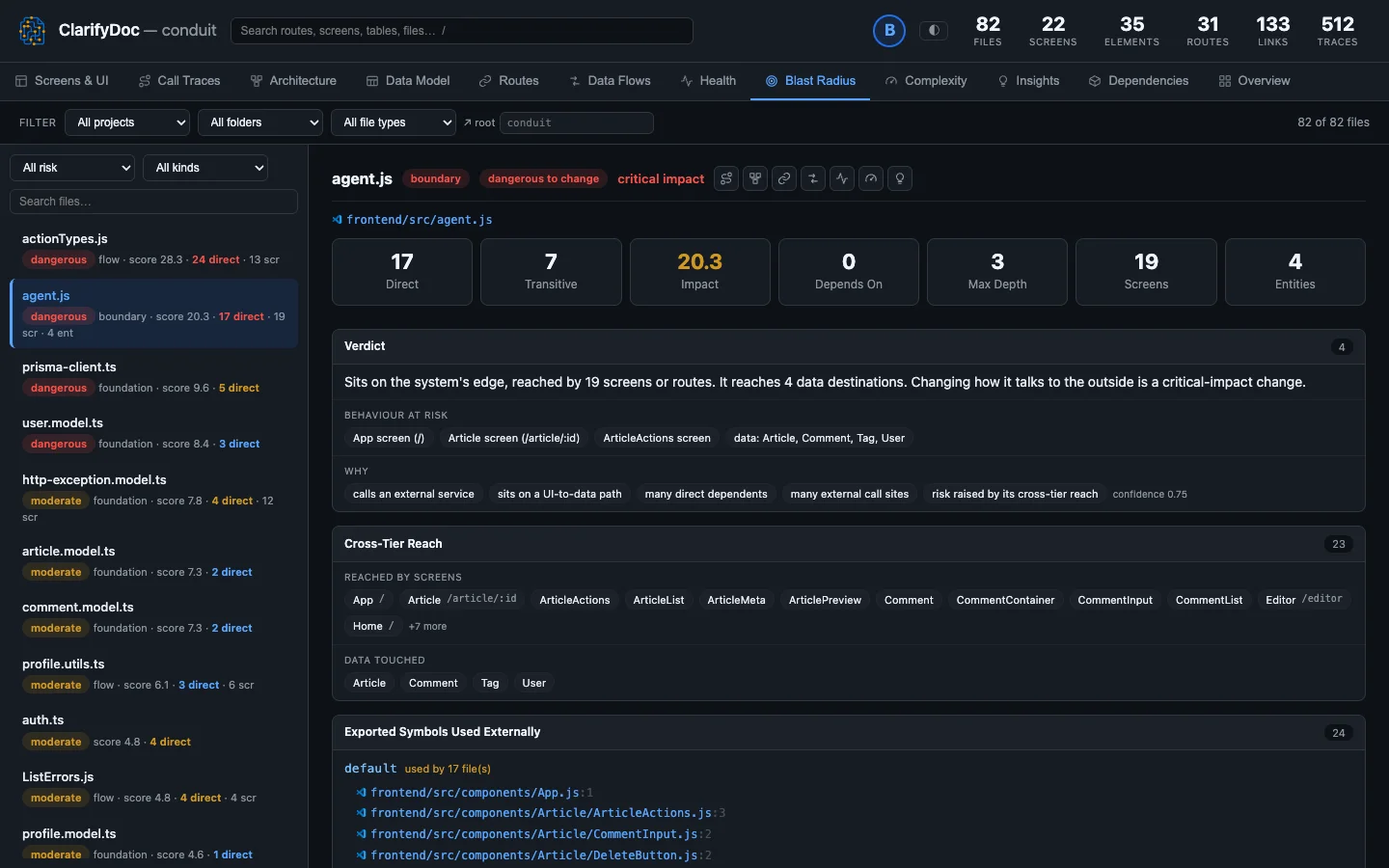 Blast Radius
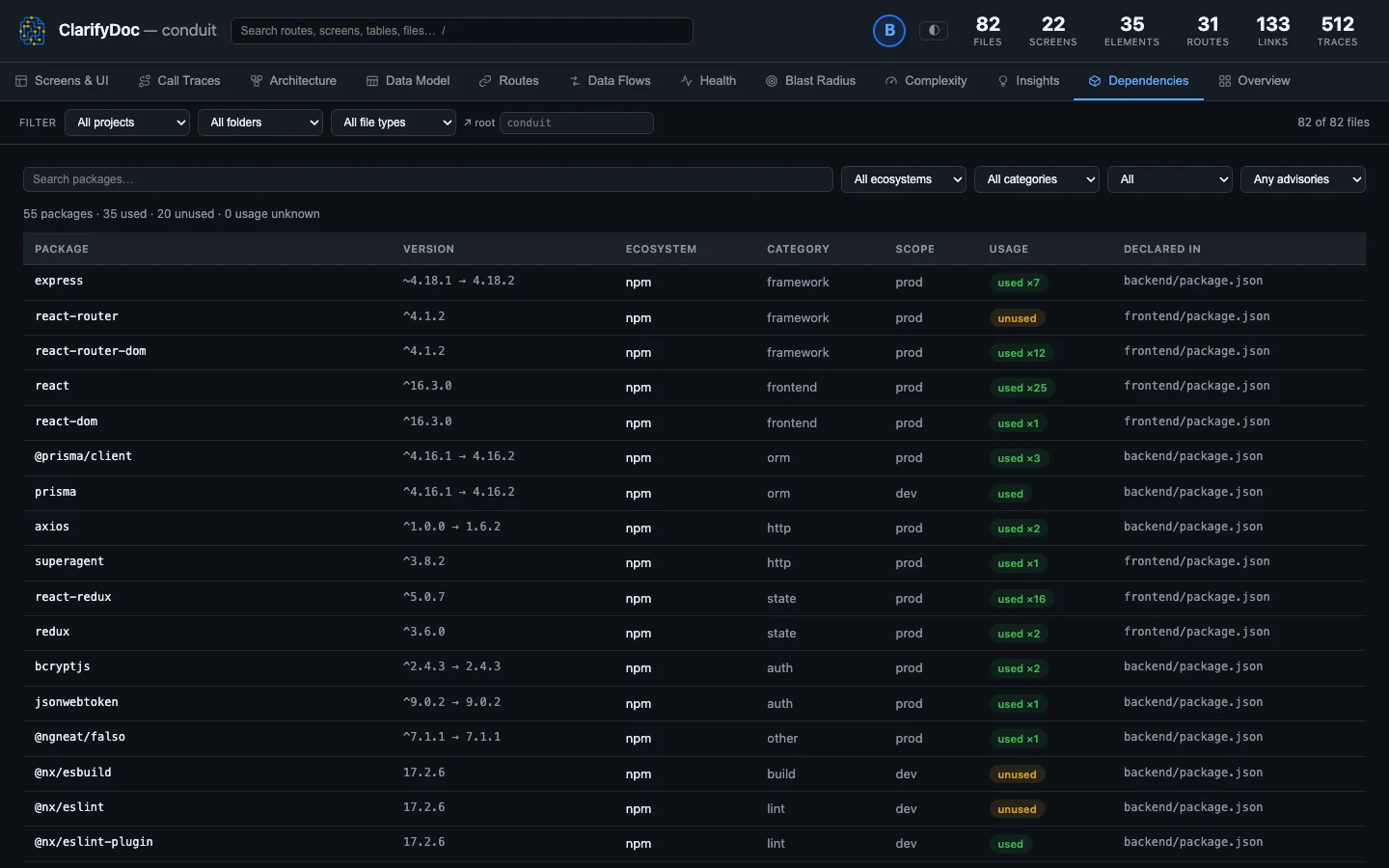 Dependencies
HOW TEAMS ADOPT IT
Low-lift to put in front of the team
Point it at the repos
A developer runs it once from VS Code, or your CI runs one command. No instrumentation, no code changes, no environment to stand up.
Share the report
The self-contained report opens in any browser — mail it to anyone, no install required.
Keep it current
Add it to CI: every pull request gets the API changes and new findings in one comment, and fails only on what it introduces.
Onboard against it
Point new joiners and partners at the live map instead of a wiki page written two rewrites ago.
GET STARTED
Map your system this afternoon
Ask a developer to run it on the codebase that runs the business — it takes minutes and needs no account. Nothing leaves your network.